UK AI Power Map: the outside-in view
When I published the UK AI Power Map, one piece of feedback came up again and again: a map of UK decision-makers misses the point, because the real influence over AI in Britain sits with the big US technology companies. Meta, Google, Microsoft, Anthropic, OpenAI, Palantir and others are already embedded in how the UK builds and buys AI.
It is a fair challenge, and only partly right. These companies, and the governments behind them, do shape a great deal of what happens here. But how much of that influence the UK accepts still depends on decisions made by people and institutions on the original map. So rather than replace one map with another, I have drawn the outside-in view: who from outside reaches into the UK system, through which channels, and where they land.
This is a personal map. It reflects my own judgement and the public sources I could find, and it is bound to be incomplete. I would welcome corrections and missing links, ideally with a source.
Interactive map
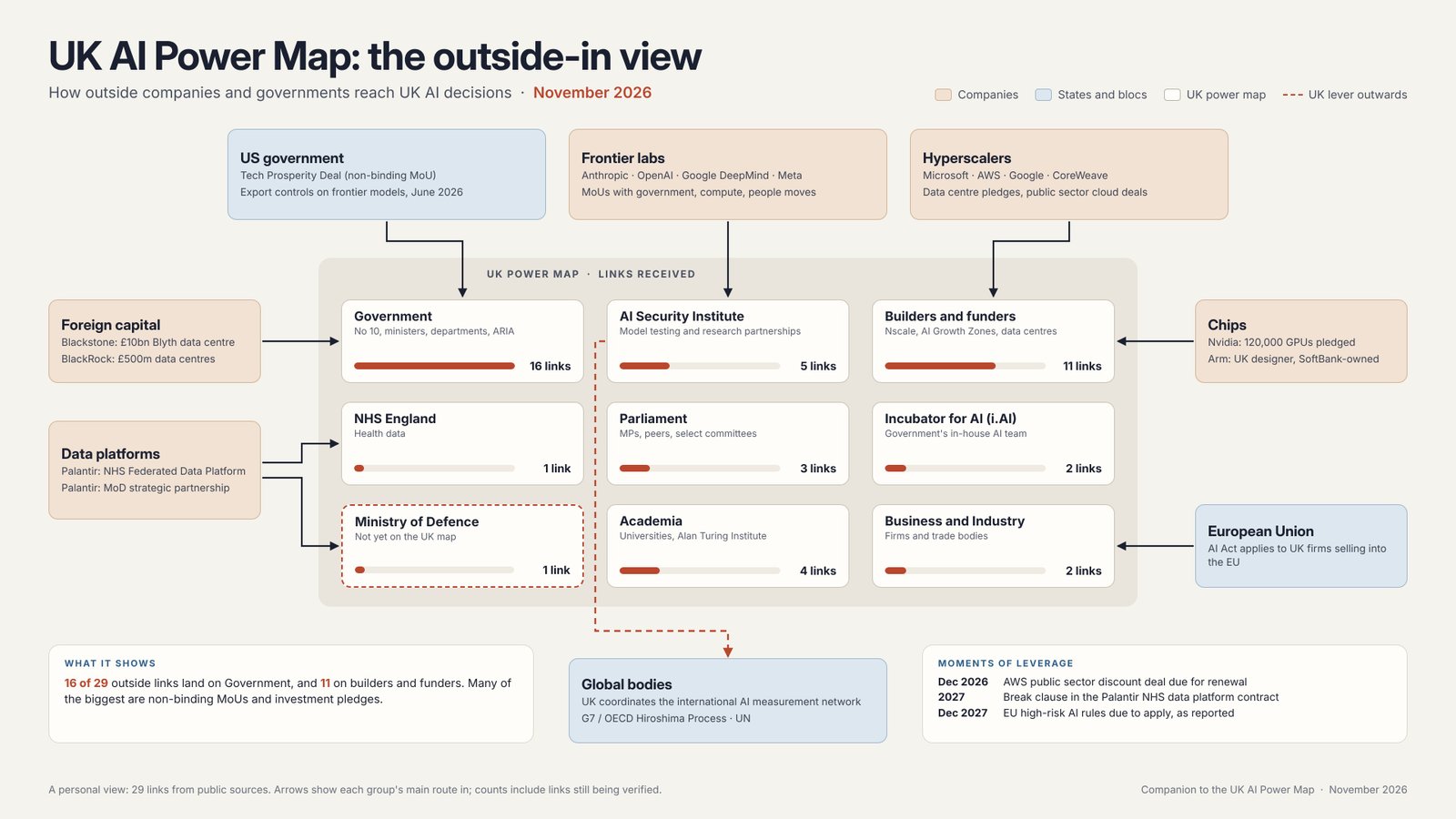
Select any group, outside or inside the UK, to highlight what it connects to and list each link with its source. Peach: companies. Blue: states and blocs. White: the UK power map.
What it shows
I recorded 29 links between outside actors and the UK system. Three things stand out.
- Most outside influence lands on government. Sixteen of the 29 links reach Government directly, through memorandums of understanding, cloud agreements, investment deals and people moving between roles. Eleven reach the UK's builders and funders, mostly through data centre and compute commitments.
- Many of the headline agreements are not binding. The Tech Prosperity Deal and the memorandums with Anthropic, OpenAI and Google DeepMind are statements of intent rather than contracts. The investment figures are pledges, not money already spent.
- The UK still has levers. Public sector buying power, the AI Security Institute's testing role and its coordination of the international AI measurement network, and the timing of contract renewals all give the UK room to negotiate.
Moments of leverage
Some of these links come with dates when the UK can choose to renew, renegotiate or walk away.
| When | What |
|---|---|
| December 2026 | AWS public sector discount agreement (OGVA 2.0) due for renewal. Computer Weekly |
| 2027 | Break clause in the Palantir NHS Federated Data Platform contract. Computing |
| December 2027 | EU high-risk AI rules due to apply to stand-alone systems, as reported following the Digital Omnibus. Official Journal |
How the map was built
I started from the groups on the UK AI Power Map and asked, for each outside actor, how it reaches into that system. Three rules shaped what went in.
- One link, one public source. Each link is a documented contract, agreement, investment, appointment or rule. Where I could only find press coverage, or where the link is my own judgement, I say so.
- Group the outsiders. Eight groups are easier to read than dozens of company names. Companies such as Google appear in more than one group because they act through more than one channel.
- Facts, not motives. People who have moved between government and these companies are shown as public, documented moves only. Nothing here implies wrongdoing.
On the map above, select any group to see every one of its links, with a source for each. The static image shows only each group's main route in. The full set of links is also listed below. The counts include a few links still being verified, so they may change.
The links in text
US government
- Tech Prosperity Deal (September 2025): a non-binding US–UK memorandum on AI, nuclear, quantum and other technologies, announced with about £31bn of US company pledges. Reaches No 10 and the business department. MoU text, gov.uk
- Export controls (June 2026): a US directive led Anthropic to suspend two frontier models for foreign nationals, including UK users, until controls were lifted at the end of June. Reaches the AI Security Institute and UK users and builders. Anthropic statement
Frontier labs
- Anthropic: non-binding MoU on AI in public services, with security research through the AI Security Institute (February 2025). gov.uk
- OpenAI: non-binding MoU on public sector use, AI Growth Zones and security research (July 2025). gov.uk
- OpenAI: Stargate UK with Nscale and Nvidia, starting at Cobalt Park in the North East AI Growth Zone (September 2025). OpenAI
- Google DeepMind: non-binding MoU giving UK scientists priority access to models, support for i.AI, a "Gemini for Government" offer and wider research with the AI Security Institute (December 2025). UK-based but US-owned. gov.uk
- Meta: $1m Open-Source AI Fellowship run by the Alan Turing Institute, placing engineers in government (July 2025). Meta
- People moves:
- Rishi Sunak, a sitting MP, became a part-time senior adviser to Anthropic and Microsoft under ACOBA conditions, including a two-year lobbying ban (October 2025). ACOBA
- Lord Booth-Smith, former No 10 chief of staff, joined Anthropic under a two-year lobbying ban (2025). Reported by The Guardian
- Matt Clifford, author of the AI Opportunities Action Plan, joined Anthropic and stepped down as ARIA chair (September 2026). Times Higher Education
Hyperscalers
- Microsoft: $30bn (about £22bn) over 2025 to 2028, including the UK's largest supercomputer with Nscale. Microsoft
- Microsoft: SPA24, a five-year agreement giving public bodies discounted Microsoft products (from November 2024). Crown Commercial Service
- Google: £5bn over two years, including the Waltham Cross data centre and DeepMind research (September 2025). gov.uk
- Google Cloud: partnership to move departments off legacy contracts and upskill up to 100,000 civil servants by 2030 (July 2025). gov.uk
- Amazon Web Services: £8bn over 2024 to 2028 for UK data centres. UKTN
- Amazon Web Services: One Government Value Agreement, giving public bodies committed-spend discounts; renewed December 2023 for three years. Crown Commercial Service
- CoreWeave: a further £1.5bn (£2.5bn in total), including a partnership with DataVita in Scotland (September 2025). gov.uk
Chips
- Nvidia: 120,000 advanced GPUs across the UK, including up to 60,000 through Nscale (September 2025). gov.uk
- Arm: a UK chip designer owned by Japan's SoftBank, whose designs sit under much of the compute build-out. My judgement
Data platforms
- Palantir: NHS Federated Data Platform, with an award notice of £182m and a forecast of up to £330m over seven years (November 2023). Digital Health
- Palantir: Ministry of Defence strategic partnership, with up to £1.5bn of UK investment and opportunities worth up to £750m over five years (September 2025). gov.uk
Foreign capital
European Union
- AI Act: applies to UK firms selling into the EU. The Digital Omnibus on AI, in force since July 2026, delays the high-risk rules. Official Journal
Global bodies
- International Network for Advanced AI Measurement, Evaluation and Science: formerly the network of AI safety institutes, with the UK as Network Coordinator since December 2025. This is a UK lever reaching outwards. DSIT announcement
- G7 and OECD: the Hiroshima AI Process code of conduct, with company reporting run by the OECD. To be confirmed
- United Nations: the UK's role in the UN scientific panel and dialogue on AI. To be confirmed
Gaps and disclosures
Some gaps are already clear. I have not yet mapped trade body memberships, think tank and university funding, or evidence given to Parliament, all of which need careful work with public registers. I have also left open whether to show China, whose influence runs mainly through hardware supply chains and security policy.
In the interests of transparency: I am Research Director at the Digital Policy Alliance, AI Director at Digital Leaders, and a Fellow of the British Computer Society. Research for this page was assisted by Claude, an AI model made by Anthropic, which appears on the map.
Tell me what I have missed
Which outside links matter most, and which have I missed? Please get in touch with your suggestions, ideally with a source.